Marine life
When is the best time to see gray whales in Baja California Sur?
Every winter, gray whales travel thousands of kilometers to the lagoons of Baja California Sur. Here is how their migration calendar works.
A journey of thousands of kilometers
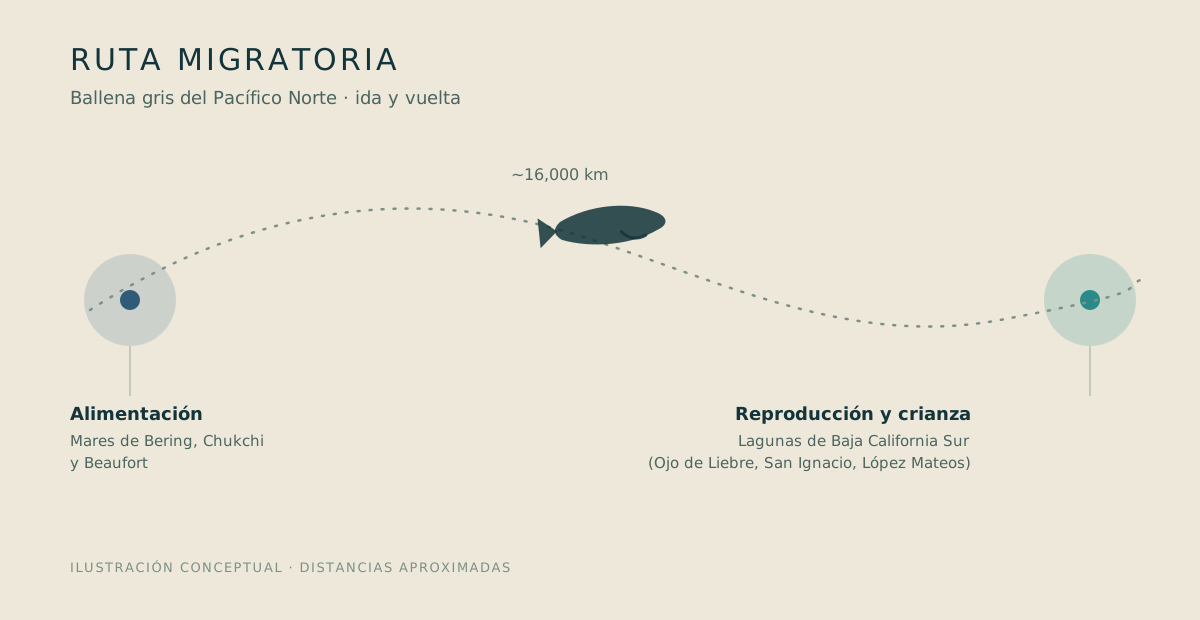
The North Pacific gray whale (Eschrichtius robustus) makes one of the longest migrations known among mammals, traveling between its Arctic feeding grounds and the lagoons of Baja California Sur on a round trip that can exceed 16,000 kilometers.
According to NOAA Fisheries, these journeys take the species across much of the eastern Pacific each year, from the Bering, Chukchi and Beaufort seas down to the Mexican coast.
When do they reach Baja California Sur?
There is no fixed date every year, but the general pattern is consistent: the first whales usually arrive in the Mexican lagoons around December, numbers keep building through January and February, and the highest presence — including newborn calves — tends to concentrate between February and March. By April, most have begun heading back north.
Ocean conditions vary from year to year, so these dates are a general reference, not a guarantee for any specific week.
Why they choose Baja’s lagoons
The sheltered lagoons and bays of Baja California Sur — such as Ojo de Liebre, San Ignacio and the Bahía Magdalena complex, where López Mateos is located — offer calm, warm water that is ideal for females to give birth and nurse their calves before the trip back north.
That shelter also reduces the risk of orca attacks, one of the species’ few natural predators and especially dangerous for newborn calves.
Confirmed dates in peak season
Con Gorra’s group departures to see gray whales in López Mateos are scheduled for 6–10 and 12–16 March 2027, within the window of highest presence of the species in the region. This does not guarantee a sighting: the animals move freely, and routes may be adjusted for weather and sea conditions.
If you are traveling on your own at other times in the season, you can check availability and recent sightings with the team.
Before you go, learn to tell them apart
Gray whales are not the only species you might cross paths with off Baja California Sur. Knowing how to tell a gray whale from a humpback — by the shape of the back, the fins and the skin pattern — helps you enjoy the encounter more, whichever species shows up.
References to keep exploring
Sources accessed on November 8, 2026. Editorial text by Con Gorra Expeditions.