Sky and climate
What happens to marine animals during heavy rain?
The rain doesn't end when you touch the sea. It can change salinity, move sediments and connect what happens on land with coastal life.
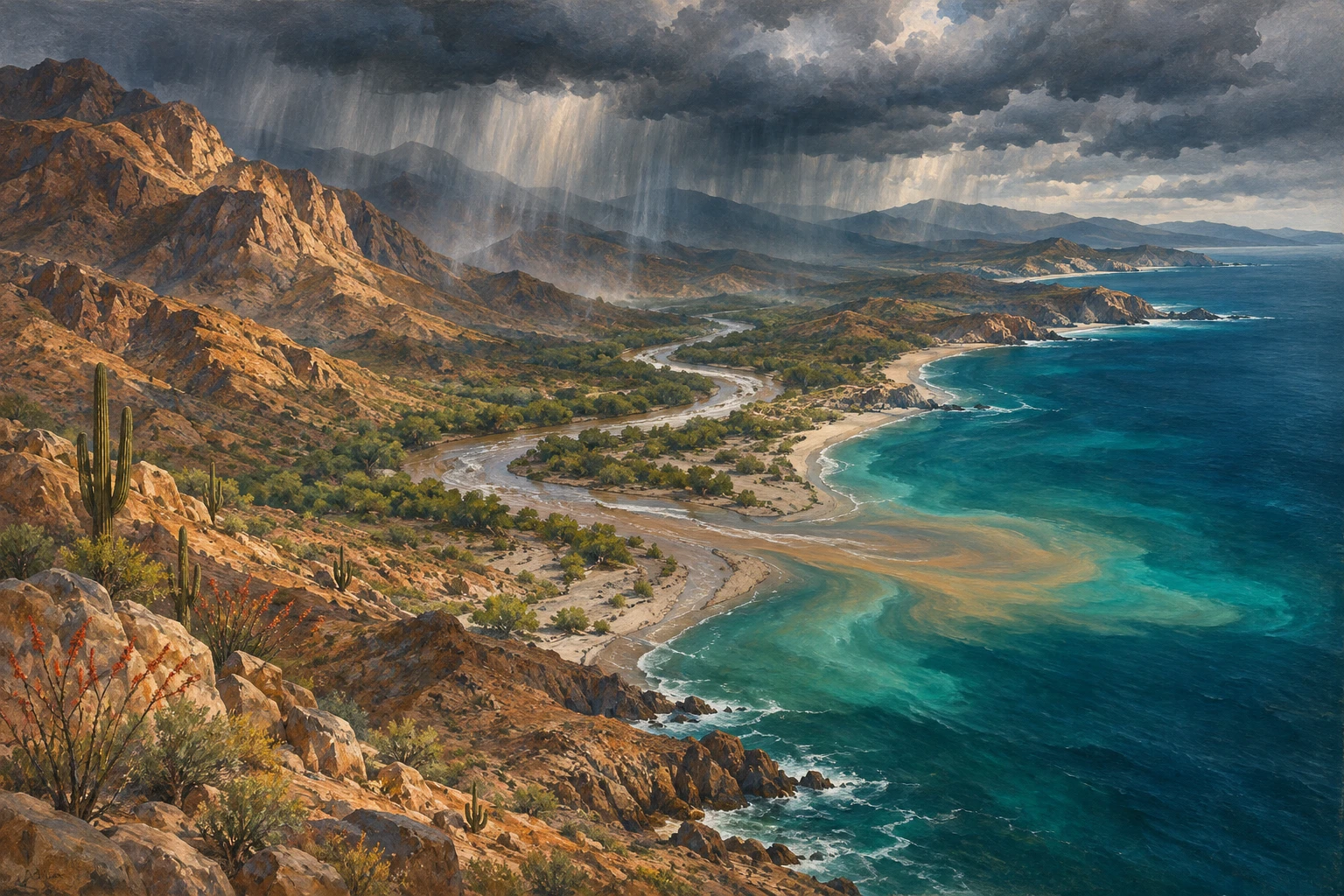
A drizzle is not the same as a hurricane
There is no one-size-fits-all answer for all animals or for all rains. The intensity, duration, place and previous state of the ecosystem matter. A coastline, a lagoon and the open sea also do not receive or disperse water in the same way.
In addition, rain should be separated from other components of a storm. Waves, currents and sediment movements are also involved in a hurricane. Not every effect observed after a storm was caused only by the water that fell from the sky.
To enlarge: [1] NOAA · How Hurricanes Affect Marine Life.
Fresh water in a salty environment
Precipitation and water inputs from the ground can reduce salinity near the surface or mouths. Salinity is the concentration of salts of water, and does not remain the same at all sites: processes such as evaporation also influence.
NOAA describes how rapid changes in salinity and temperature during hurricanes can affect wildlife. The ability to move or tolerate such changes is different between agencies; therefore we cannot sum it up by saying that everyone simply goes somewhere else.
To enlarge: [1] NOAA · How Hurricanes Affect Marine Life, [3] NOAA · Why the ocean is salty.
What comes from the ground also counts
The water can travel streets, soils and channels before reaching the sea. That flow can carry particles and materials from the ground. During a storm, in addition, the movement of the bottom can cloud shallow areas and reduce the light that reaches certain organisms.
This is how the connection between the basin and the coast is understood: the landscape we see from the boat also includes what happens inland. It is not enough to fix the colour of the surface to know all the water conditions.
To enlarge: [1] NOAA · How Hurricanes Affect Marine Life.
Nutrients, algae and oxygen
Nutrients are part of ecosystems, but an excessive contribution can lead to abundant algae growth. NOAA calls eutrophication nutrient enrichment that can trigger this process.
Decomposition of organic matter can help reduce the oxygen available. In cases of lack of oxygen, fish and other organisms may be affected. This does not mean that any rain produces a flowering of algae or a mortality: we need to know the conditions and measure what really happened.
To enlarge: [2] NOAA · What is eutrophication.
What does it mean for an exit to the sea?
A general explanation does not allow us to state how a bay will be after a concrete rain. For an expedition, local conditions and equipment indications are important; itineraries can be adjusted by weather.
If an exit changes, it is worth asking what conditions are being considered. Learning about the sea also includes accepting that it does not always behave like the photograph we imagined before arriving.
References for further exploration
Sources accessed on November 6, 2026. Publication text by Con Capra Expeditions.